
A filing is the start of a process
Matt Wolfe opens his 31 October 2026 weekly report with Anthropic’s proposed initial public offering, or IPO: selling company shares to public investors. An S-1 is the registration document used for this process. It describes the business, finances, ownership and risks. Filing it does not mean trading has begun.
The company’s 26 October announcement confirms the filing and proposed Nasdaq symbol ANT. It says the share count and offering price range are still undetermined. Therefore the video’s anticipated 16 November listing and $1.5–2 trillion valuation remain expectations, rather than completed or officially priced events.

Revenue and accounting losses answer different questions
Reading a table on screen, Wolfe reports $4.585 billion of 2025 revenue and more than $16 billion for the first half of 2026. He also points to an approximately $80 billion net loss for that half-year. These are the presenter’s reading of the filing, not independently audited figures supplied by this article.
He notes that convertible financing and valuation changes can affect accounting losses. A net-loss line cannot simply be treated as cash leaving a bank account. The video offers a simplified explanation; it does not provide a complete reconciliation of cash flow, operating losses and financing adjustments.

Employee wealth estimates are conditional
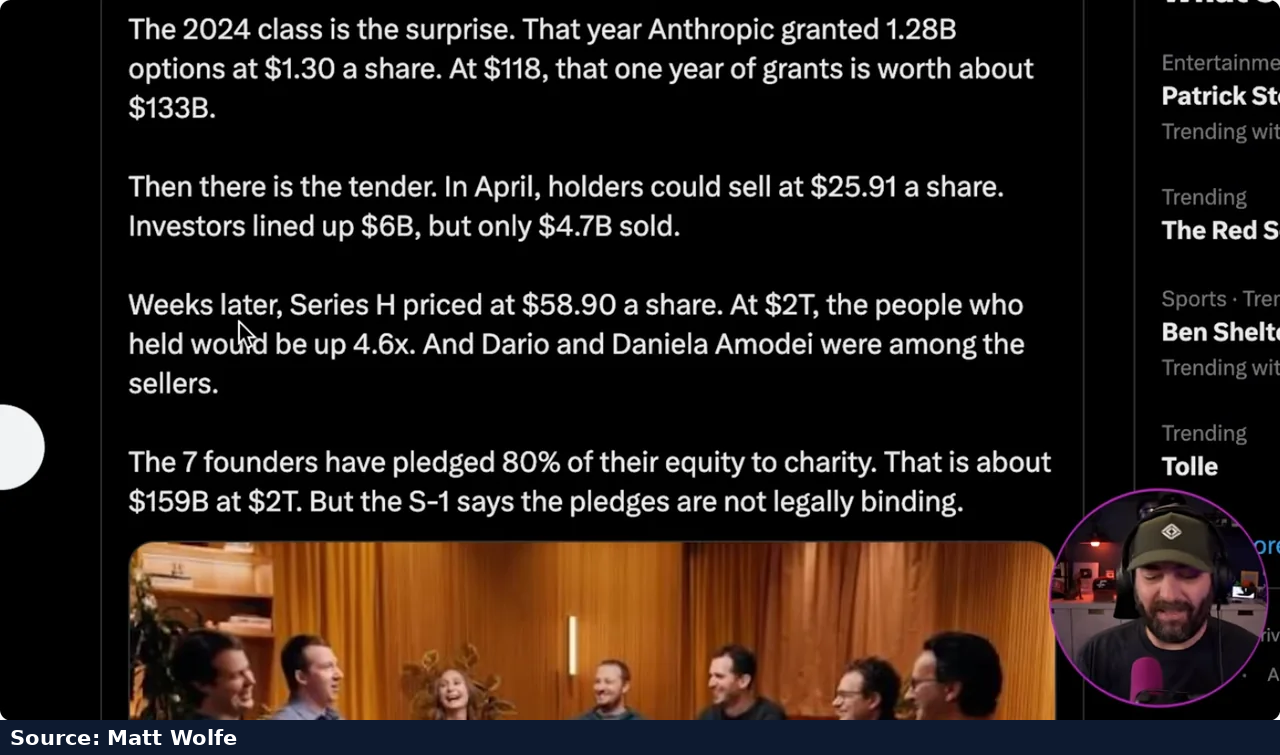
Wolfe cites an Andrew Benson social post, explicitly warning that he did not check all its arithmetic. At a hypothetical $2 trillion valuation, the post estimates about $118 per share, $199 billion for seven controlling co-founders, $100 billion for a public benefit fund and $331 billion in employee options and restricted stock units. Across roughly 5,300 employees, that would average about $62 million, with very unequal allocations.
The post estimates $110–400 million each for 300–500 people hired by 2023; $200–300 million for 440–640 hired in 2024; $70–95 million for about 1,360 hired in 2025; and $10–20 million for around 3,000 hired in 2026. Its estimate of 940 people reaching nine-figure holdings is a scenario, not a guaranteed payout.


Paper value is different from money received
The video contrasts an April transaction price of $25.91 and a later Series H figure of $58.90 with the hypothetical $118 listing price. Comparing those figures does not establish an investor’s realized return: terms, dilution, taxes and sale restrictions also matter.
Shares, options and restricted stock units are different instruments. An estimated holding value is not an automatic payment to an employee. Wolfe mentions a typical six-month insider lockup; the actual offering terms must determine the real restriction. His comments on Amazon, Google and Broadcom describe potential equity exposure and commercial relationships, not verified cash distributions.
What this could tell us about the AI market
Wolfe sees a specialist frontier AI company’s listing as a test of investor confidence. His proposed signal is what insiders do after restrictions expire. That is commentary: a sale can have many motives and cannot alone prove an AI bubble.
The useful reading order is the official offering document, its final terms and subsequent filings. Keep three labels separate: company disclosures, third-party valuation estimates and the presenter’s interpretation. The share price and timing were not final in the announcement checked on 1 November 2026.