
The coat stays the same. The face stays the same. But does the person on screen still remember the conversation from the previous scene? That is one of the questions hiding inside a wonderfully simple idea: come home, describe a movie, then watch it.
I imagine coming home and describing the film I want instead of choosing a title from a catalogue. I might pick its characters from a gallery and ask a system to turn a few preferences into a story made for my evening.
Current production tools provide pieces of that experience. The sources reviewed here do not establish a service that reliably delivers a coherent, personalized feature film within a few minutes. Understanding the distance between those two things makes the idea more interesting, rather than less.
My evening in Paris: describing the film I want
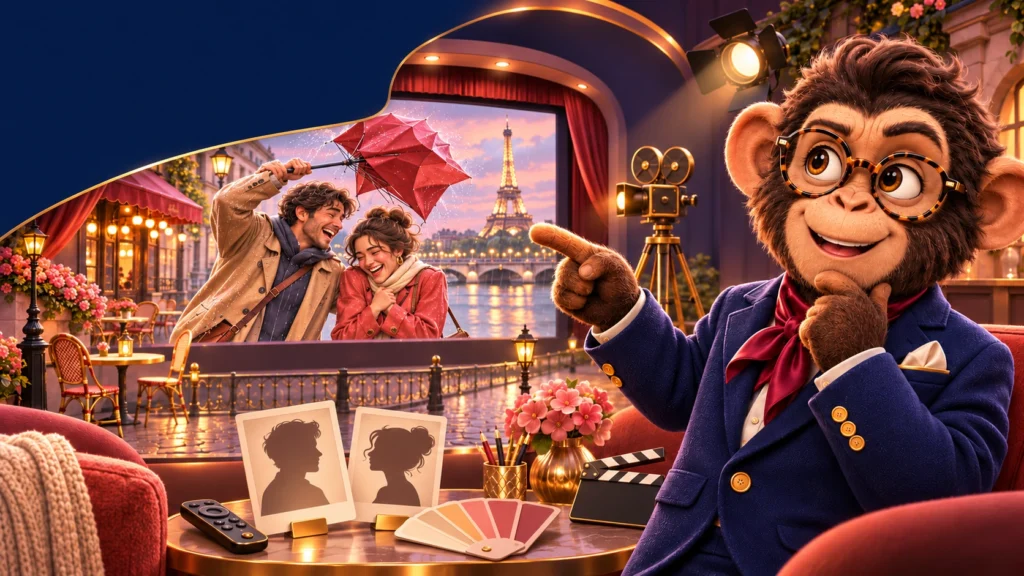
In my imagined evening, I choose two characters and make them lovers. I set their story in Paris, ask for a romantic comedy, describe the atmosphere of a favourite reference film and specify its colours. After five or six questions, I want the film to be ready within minutes.
The crucial change is the viewer’s position. A catalogue asks which finished work you want. This imagined service asks which decisions you want to make before a work exists. Its convenience would depend on making the rest of those decisions well.
Six answers leave an enormous amount unspecified. Why do the lovers disagree? What makes their reconciliation credible? Which detail in the opening should return in the ending? A short conversation with the viewer could conceal a considerable amount of writing, visual planning and revision.
A phone-shaped story is a format, not a production method
Short dramas on TikTok and Instagram offer a useful starting point for this thought experiment. Their contained stories help me picture a smaller production before imagining a feature-length film. A vertical series can use human actors; an AI-generated film can be widescreen. Screen shape and production method remain separate choices.
Short drama nevertheless offers a plausible place to explore the idea. A contained relationship and a small number of locations leave fewer continuity decisions to manage than a sprawling feature. That is our production analysis, not a measured success rate. A small story can still be difficult to write, and short running time does not remove the need for motivation or an earned ending.
The attraction is easy to imagine: a clear emotional situation, quickly understood, that leaves you wanting another scene. AI could help create variations of that structure. Whether the variations hold attention is a different question from whether a tool can generate them.
What the existing tools actually document
Topview describes Drama Studio as a connected workflow for story planning, editable characters and locations, storyboards and episode production. Its published process includes review stages. That supports the idea of translating a request into structured production work; it is not evidence of an effortless feature-film service.
Higgsfield’s Popcorn documentation describes connected storyboards of up to eight frames with up to four image references, followed by animation through video models. The distinction matters: a visual sequence is a plan for moving images, not a finished movie. We could verify Popcorn and Cinema Studio, but not the current scope of a separately named Higgsfield “Drama” product.
There are therefore several layers behind the apparent single request. An application organizes the story and assets. A video model generates moving images. Editing arranges those results into something watchable. A workflow that plans episodes does not imply that its underlying model generates the entire series in one pass.
The model supplies a shot; the film needs continuity
According to Higgsfield’s Seedance guide, Seedance 2.5 offers 4–30-second clips with synchronized audio and is available through Pro and Plus plans and above. Those are platform-specific documented conditions, not a promise that one generation produces a long film.
Google DeepMind’s Veo page documents audio-video generation, visual references and scene extension, while acknowledging remaining work on natural, consistent speech and synchronization. These are meaningful components of filmmaking. They do not by themselves settle the larger question of sustained storytelling.
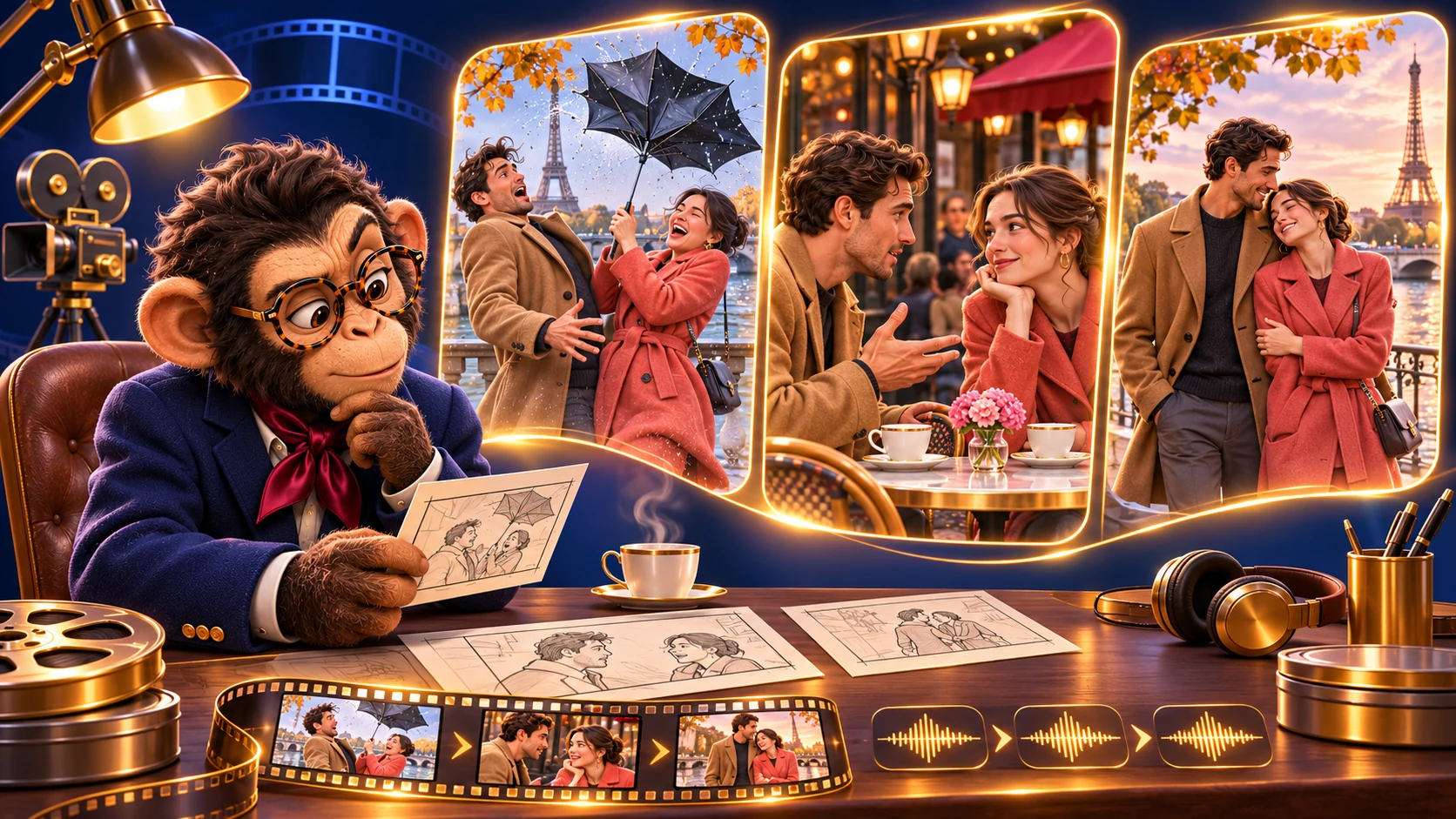
Return to Paris. The lovers need to look like the same people when they leave the river and sit down in a café. Their voices should remain recognizable. More subtly, a joke or disclosure in the café needs to affect what happens next. A character can retain the same face and still break the story by forgetting something they learned.
Camera decisions carry meaning too. Showing an embarrassed reaction before a punchline lands produces a different scene from holding it back. A convincing image cannot tell us whether the cut arrives at the right moment. Personal cinema would need control over both appearances and relationships between shots.
[Body illustration: 02_Ic_Gorsel_Kisisel_Film.webp]
AI-generated conceptual illustration. Produced by FoxAI World. It visualizes character and story continuity; it is not a real product interface or a test result.
The clock must measure the finished experience
“Ready in minutes” could mean several things: an outline, the first clip, a rough assembly or the final film. Waiting in a queue, regenerating unusable shots and repairing sound can change the total substantially. No end-to-end timing experiment using this Paris scenario was performed for this article.
A useful future claim would identify the finished running time, resolution, queue conditions and human intervention involved. It would count rejected attempts as well as successful ones. Otherwise, a fast first image could disguise a much longer production process.
Another possibility is to prepare the opening while generating later scenes during playback. That is a possible architecture considered in this analysis, not a verified feature-film service offered by the products above. It would also need enough story planning to avoid contradicting earlier scenes, particularly if viewers could alter the direction halfway through.
A film that knows your taste still needs something to say
Personalization could make unusual combinations accessible: a preferred language, a particular atmosphere, chosen characters and a length that fits one evening. Its value might lie in making a story that a mass-market catalogue would never carry.
Yet satisfying preferences and creating a memorable work are different creative problems. A film sometimes matters because it takes a turn we would not have requested. A system shaped around our taste would need room to surprise us. This is a critical question raised by the scenario, not a finding from audience research.
Shared viewing could change as well. If every household gets a different ending, conversations may become partly about the choices people made. Finished works could continue alongside personalized ones. There is no technical reason in the evidence reviewed here to declare that one must replace the other.
Reference films deserve precision too. A request can describe palette, pacing and mood separately, instead of treating an existing title as an instruction to reproduce it. Selecting a reference does not itself provide permission to use an existing work; relevant terms would need separate review.
How I would recognize progress toward personal cinema
A useful proposed pilot would keep the Paris premise fixed and follow the same lovers through an establishing shot, dialogue and a later location. Review identity, intelligible speech, camera intent and whether one event explains the next. Record the time and cost of every attempt needed to obtain the usable sequence. This is a suggested evaluation, not a test we have already run.
The eventual milestone would be a complete experience that meets its own promise: the requested characters and setting, an understandable story, a satisfying finish and a clear account of how long it took to prepare. More polished individual shots would be progress, but would not establish all of those things.
For me, the interesting change begins in the living room. I describe the experience I want, and production moves behind that conversation. Existing tools show how some of the work could be organized. The harder step is making every later scene deserve the one before it.