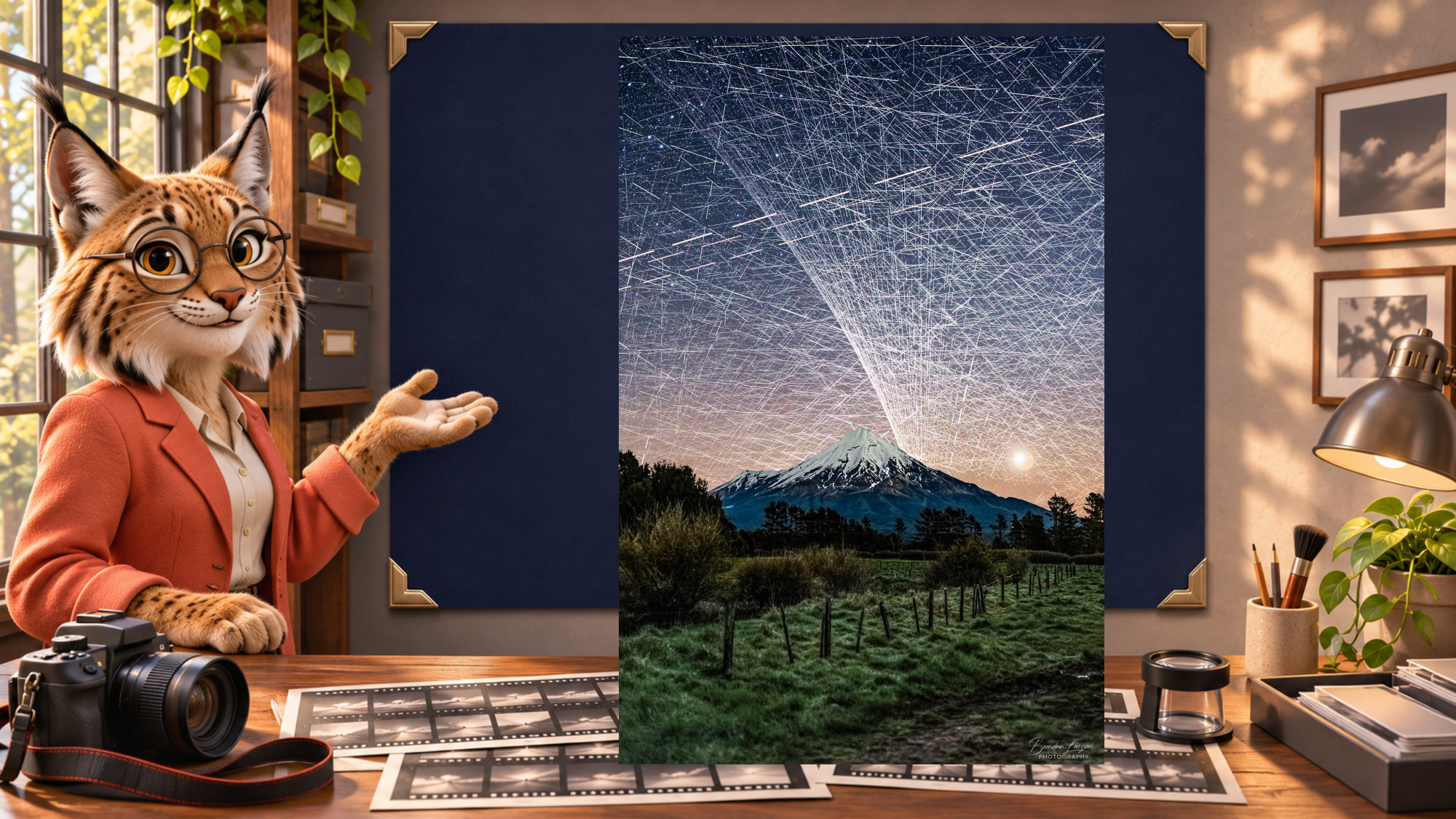

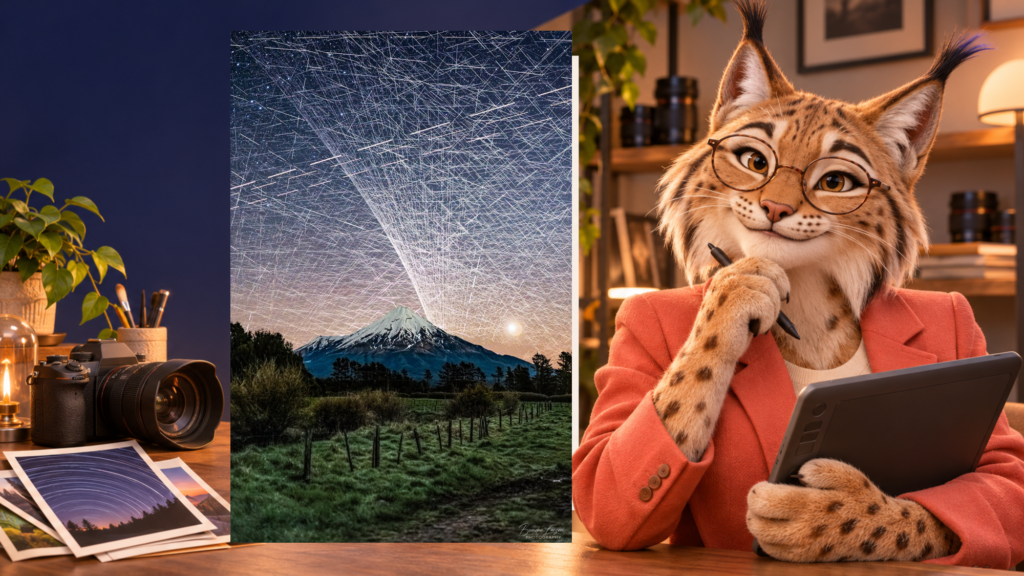
A dense web of light above Mount Taranaki has brought New Zealand photographer Brendan Larsen an unusual challenge: explaining why his work should not be mistaken for an AI image. His account describes a camera-based composite assembled from hundreds of exposures.
How the photograph was made
In his original post, Larsen identifies a September 9, 2026 session lasting nearly two hours. The camera recorded 578 eight-second exposures. The finished picture gathers the trails from that sequence into one view.
What the trails represent
The striking total needs a little context. Larsen estimates roughly 1,400 individual satellites and more than 14,000 trail appearances. A satellite can appear in several consecutive frames, so each line does not represent a different spacecraft. Nor does the composite show every trail visible at a single instant.
That distinction is the key to reading the picture. Layering makes motion over time visible as a pattern. It also changes what the viewer is being shown: the image condenses a sequence rather than presenting an untouched exposure. The use of editing software does not, by itself, establish that generative AI was involved.
Larsen says he documented the process as well. For viewers, original frames and a clear explanation of the editing provide a more useful way into the question than visual surprise alone. An extraordinary appearance can prompt investigation; it cannot settle provenance.
The photograph in this package remains credited to Brendan Larsen Photography. FoxAI’s surrounding illustration is a separate creative layer, allowing the work and the editorial presentation to be identified independently.