

Picture two 23-year-olds who graduated the same year. One looks for work in a job where AI tools can take over many routine tasks; the other in a field where AI mostly helps people do their work. According to new Stanford data, the first group’s employment has fallen well behind the second. The size of that gap has now grown to 19 percent.
What the updated study finds
The paper, “Canaries in the Coal Mine? Six Facts about the Recent Employment Effects of Artificial Intelligence,” is by Erik Brynjolfsson, Bharat Chandar and Ruyu Chen of the Stanford Digital Economy Lab. The first version came out in August 2025; a revised version was published on 12 August 2026.
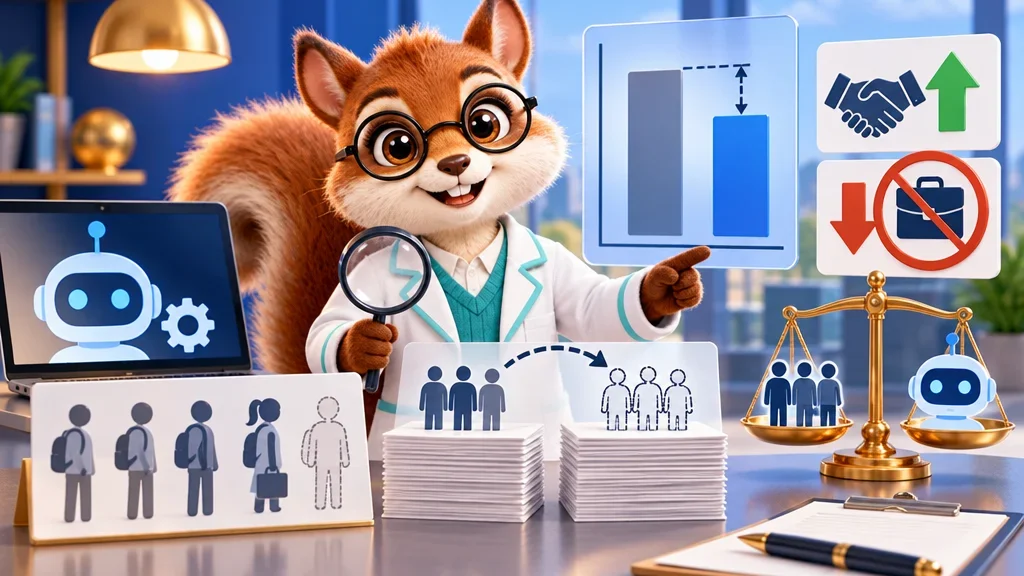
The headline result: employment of workers aged 22 to 25 in highly AI-exposed occupations is about 19 percent below where it would be if it had kept pace with similarly aged workers in less-exposed jobs. In the July 2025 data, the same gap was 15 percent. Experienced workers show no comparable gap.
In plain levels, the lab reports that from November 2022 to June 2026, employment of 22- to 25-year-olds in the two most exposed groups of occupations fell about 11 percent, while it grew about 10 percent in the three least exposed groups.
How it was measured
The interesting detail is in the method. The authors use payroll records from ADP, a large US payroll provider, covering millions of workers through June 2026. They sort occupations into five groups, called quintiles, according to how exposed their tasks are to AI. A counterfactual is the comparison path: what employment would have looked like if young people in exposed jobs had moved in step with young people in less-exposed ones.
So the 19 percent is not a drop in total jobs. It is a gap between two groups of the same age.
Fewer hires, not more layoffs
The study’s first fact is that the authors “do not see widespread, economy-wide job displacement associated with AI.” The adjustment instead runs mainly through reduced hiring of young workers rather than more people leaving or losing jobs. It also shows up in employment numbers, not in base pay.
This matters more than it sounds. A layoff wave is visible: it makes headlines and appears in unemployment claims. A hiring slowdown is quieter. The jobs that never open do not show up as losses for anyone already employed. My reading is that for a recent graduate the practical question is less “will I keep my job?” and more “will the first door open at all?”
Which jobs are affected
The declines are concentrated in occupations where AI tends to automate or substitute for tasks. Where AI mainly complements workers, employment is flat or rising, especially for experienced staff.
The revised paper adds a distinction between codified knowledge, the kind written down in textbooks and procedures, and tacit knowledge, learned through experience. Declining employment for young workers lines up with the first; rising employment for experienced workers with the second. The authors also note that women face higher AI exposure on average and say they will monitor it.
Does this prove AI is the cause?
No, and the authors say so directly: these are “descriptive patterns, not causal estimates.” The gap survives several checks. It persists when technology firms and computer occupations are excluded, when controlling for exposure to interest-rate increases and for remote work, and with alternative AI-exposure measures.
There are also real caveats. The gaps shrink when education is taken into account, some differences began before generative AI was widely used, and the gaps are larger in the ADP sample than in national survey benchmarks. The education point deserves attention: part of what looks like an AI-exposure effect may partly reflect which degrees lead into which jobs. That is my interpretation, not a finding of the paper.
To follow the trend, the lab and ADP Research run a Canaries Dashboard that updates the key results monthly; its last listed update was 21 October 2026.
Ask AI about this article
Opens in a new tab with the question filled in.