Designing a circuit board is slow, fiddly work: pick the parts, draw the schematic, route every copper track, then wait to find out whether the thing actually powers up. On 9 November 2026 Anthropic said Claude Fable 5.2 had done that whole chain for three small devices, and that all three worked. Here is what was really shown, and what was not.
What Fable 5.2 designed, and from what prompt
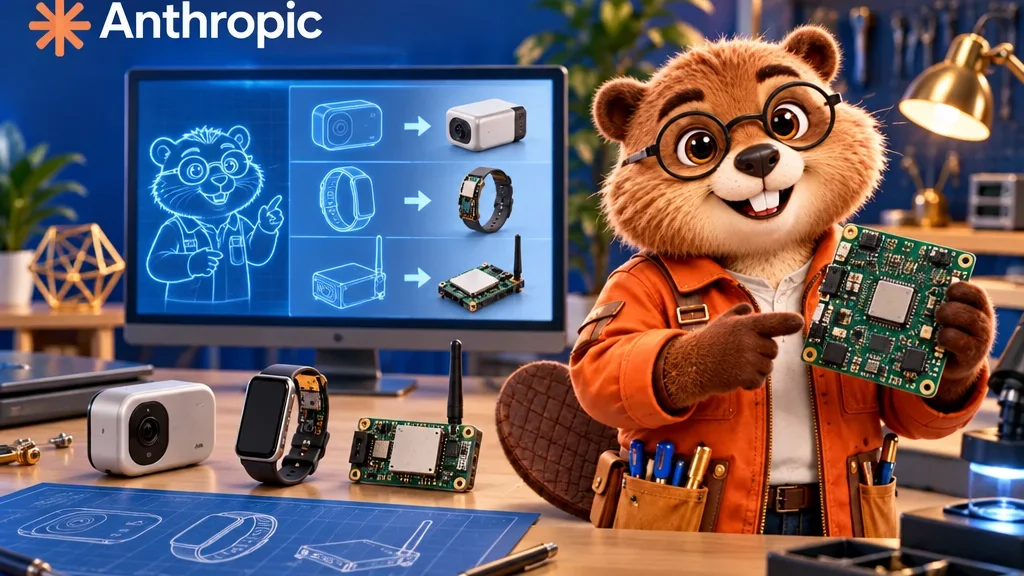
Anthropic’s launch post for Fable 5.2 describes three devices: a home voice-assistant hub, a USB speakerphone and a handheld virtual pet. Each one has its own circuit board, a 3D-printed enclosure and its own software. A circuit board, or PCB (printed circuit board), is the flat board that carries the chips and the copper tracks connecting them. The starting point was short. For the speakerphone, Anthropic’s research post quotes the request as a puck that plugs into a computer over USB-C, with microphones, a speaker and Bluetooth using an antenna printed on the board.
Which steps the model did, and where people stepped in
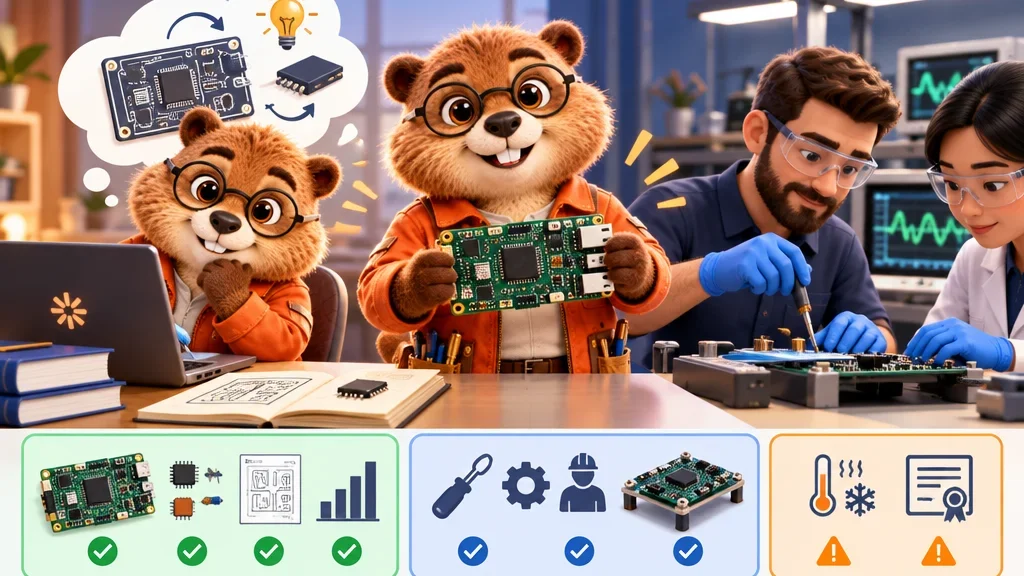
According to Anthropic, Claude wrote the specifications, drew the schematics, chose components from US distributors, placed them and routed a four-layer board. “Four-layer” means the copper wiring is stacked in four levels inside the board, which is common for compact electronics. It also ran design-for-manufacturing checks, the rules that tell you whether a factory can actually produce the board, then modeled the enclosures in CAD and wrote the firmware. Along the way it wrote its own routing tool in about half an hour.
The human side was small but real. Engineers at Diode, a company that designs and manufactures circuit boards, gave short directions such as “clean up the schematic” and “continue”, and asked one question: would the pet run without a battery? Claude read the charger’s datasheet and predicted it would run on USB power, with a flickering charge light. Diode’s team then built the boards and assembled and tested the devices while Claude guided them. Anthropic says each board was ready for manufacturing in under a day.
Did the devices actually work?
Yes, by Anthropic’s account. All three devices worked without any electrical modifications, and the company says they were still working after weeks of use. The details show real engineering decisions. The speakerphone firmware dims its LED ring as the audio gets louder, to stay under a current limit. On the hub, the microphone opening was reshaped into a wedge, which moved its resonance from about 3.4 kHz to about 8.9 kHz. The design checks also flagged six slivers of solder mask, the thin protective coating on a board, as too thin, and Claude widened them.
How much better than earlier models?
Anthropic reports two benchmarks. On Diode’s PCB Gym, which tests component placement and rerouting, Fable 5.2 scored 69 percent against 25 percent for Fable 5. On BenchCAD 2.1, which asks a model to rebuild 3D parts and boards from drawings, it scored 83.5 percent, nearly double Fable 5.1. The research post says earlier models often produced boards that were almost complete but still unusable.
The limits you should keep in mind
These are early prototypes. Anthropic states that the devices have not gone through electrical validation, antenna tuning, thermal testing or certification, and that Claude was not connected to test equipment or manufacturing machines. Anthropic also discloses a commercial relationship with Diode. All results come from Anthropic and its partner, not from an independent lab.
Our take: the bottleneck moves
Open the case. Look at the job. The facts above say a model can now take a short brief to a board that a factory can build. Our reading, which is an inference rather than a reported result, is that the slow part of hardware work shifts. Drawing and routing get cheaper. Measuring, certifying and living with a device do not. For a maker or a small team, that could mean many more prototypes on the bench, and the same amount of testing to decide which one deserves to exist. Anthropic says its next steps are denser and faster boards, checks in simulation and learning from measurements of finished devices. Those are the steps that will show whether this scales beyond three well-chosen gadgets.
Ask AI about this article
Opens in a new tab with the question filled in.