
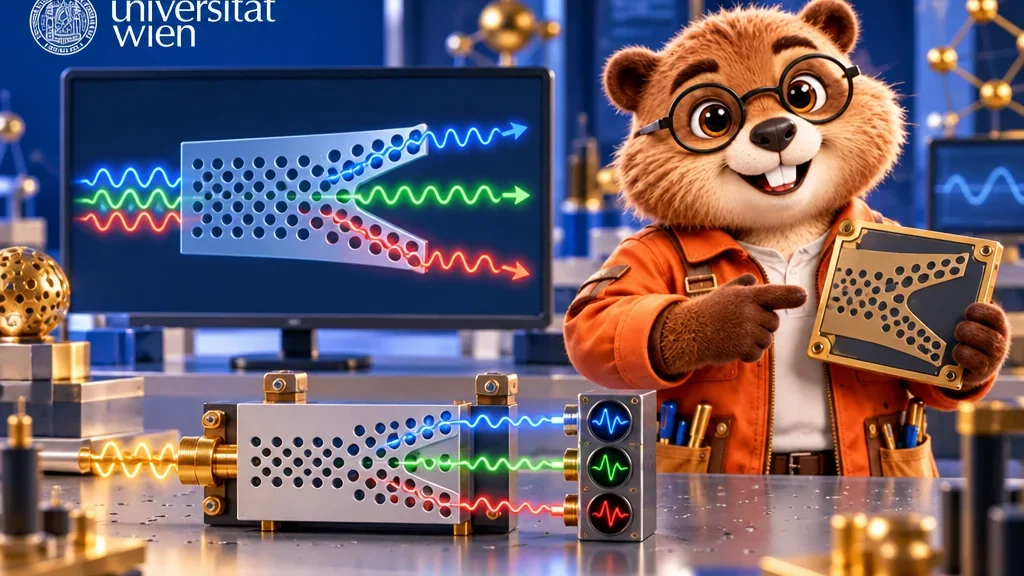
Feed two frequencies into one channel and send each to a different output. That is the job of a frequency demultiplexer. When the signals are spin waves, the device has to guide collective oscillations of magnetisation through a magnetic material. Inverse design starts by specifying which frequency should come out where. An algorithm then searches for a structure or a setting that produces that response.
How a grid of holes routes the waves
In a 2021 simulation, Qi Wang and colleagues divided a square region of magnetic film one micrometre on a side into a 10-by-10 grid. Each cell could contain magnetic material or be left empty. A direct binary search flipped cells between those two states, simulated the resulting wave motion and kept changes that improved separation at the outputs.
In the model, waves at 2.6 gigahertz travelled mainly to one output and waves at 2.8 gigahertz to the other. The holes changed the paths the waves could take. Where waves met, they reinforced or weakened one another. The optimised pattern made that interference favour a different exit at each frequency.

How the lab device adjusts the route
In 2025, a University of Vienna team demonstrated frequency separation on a reconfigurable device. It placed 49 individually controlled current loops above a film of yttrium iron garnet, a magnetic material. Changing the currents reshaped the magnetic field across the film and changed how the waves travelled. The search algorithm used measurements at the outputs as feedback to find a setting that separated the signals. The team also configured the same hardware as a notch filter, which suppresses a selected frequency band.
What matters when making the component
Both demultiplexers used optimisation against a target response. Neural-network methods are a separate line of research within inverse design. In a 2026 review, researchers identified fabrication and systematic tolerance tests for designs with a fixed geometry as open steps.
For a component with a fixed hole pattern, I would put repeatability first. You can retune the magnetic field in the 49-loop setup if the response shifts. Once the holes are made, the geometry is fixed. Measuring the separation on several manufactured samples would show how much variation the design can handle.
Ask AI about this article
Opens in a new tab with the question filled in.