
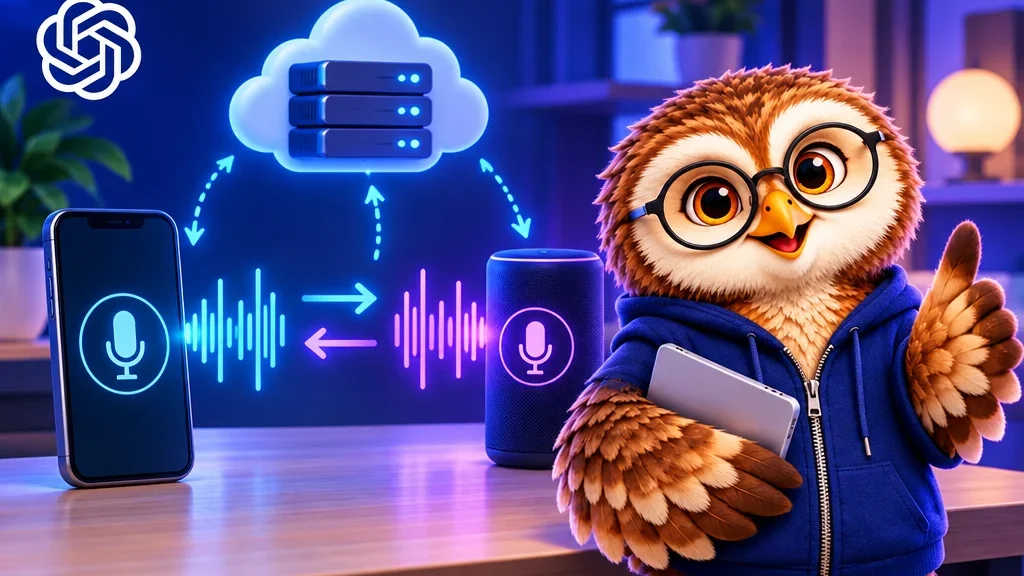
If your voice agent still waits for silence before it answers, GPT-Live-1 asks an awkward question: why wait? OpenAI made the model available in its API on 10 September 2026 at $0.05 per minute for the front-end voice layer. The pitch is a single model that listens and speaks at the same time.
What full duplex means in practice
Most voice agents are chains. Speech-to-text turns your words into text, a language model reasons over it, and text-to-speech reads the answer back. OpenAI says every handoff adds delay and creates a place where timing, context or the natural rhythm of a conversation can get lost. Developers also end up coordinating the stages themselves, including what happens when someone interrupts, pauses or changes direction.
“Full duplex” is the telephone term for both sides being able to talk at once. GPT-Live-1 applies it to one model that evaluates incoming and outgoing audio together. It can react immediately when you cut in or add a short “mm-hm”, and it can keep the conversation going while deeper work runs elsewhere. It is not a turn-based model, but it still detects turn boundaries, so apps that depend on clear turns can keep working that way.

How the backend fits in
The voice layer is deliberately thin. GPT-Live-1 can hand reasoning and tool calls to a text model in the backend, such as GPT-6 Astra, or to a third-party model. OpenAI’s own example pairs a lighter model like Luna with high-volume jobs such as scheduling or order updates, and a model like Astra with harder customer problems. In a DevDay 2026 session, presenters showed the same split live: the voice kept talking while a separate agent did the work and passed results back. For teams that already have an agent setup they trust, that means adding a voice rather than rebuilding.
What OpenAI reports so far
OpenAI reports a 30-point gain on Full Duplex Bench over GPT-Realtime-2.1, plus large improvements in turn-taking latency and interaction behaviour. Paired with GPT-6 Astra at medium reasoning, it ranks first on Tau3, a benchmark of end-to-end voice agent tasks. Speak, a language-learning company, saw in early evaluations that its tutor gave students more time to think before responding and cut interruptions by nearly 80 percent compared with earlier turn-based systems. One customer quoted by OpenAI says the model simplified its codebase by 80 percent and removed 23,000 lines of code compared with its chained architecture.
These are vendor-reported figures, and results depend on the backend model and settings. They show where OpenAI sees the gains, not how your own app will behave.
Controls, voices and price
Developers set tone, speaking speed and conversational style through the system prompt. The model is meant to handle background noise and silence without interrupting the conversation or narrating every step, and OpenAI lists long-session reliability and phone calls among its strengths. It also provides built-in speech-recognition transcripts and response text, and supports prioritising keywords. The launch page lists twelve voices, including Quartz, Ripple, Vesper and Willow, and OpenAI says it will expand voices and languages in the coming months. Custom voices go through OpenAI sales.
Editor’s assessment
First, isolate the change. What is new is not that a model can talk; it is that turn handling moves out of your code and into the model. The price is a fact worth reading closely: $0.05 per minute covers only the front-end voice layer, so your backend model and tools cost extra. My inference is that the real bill is a sum of two parts, and the voice layer stays cheap only if your backend choices do too. If you run a chained stack today, the practical test is simple: replay your messiest calls, the ones with interruptions and long pauses, and compare how each setup copes.
Ask AI about this article
Opens in a new tab with the question filled in.