Drug development beyond molecule design
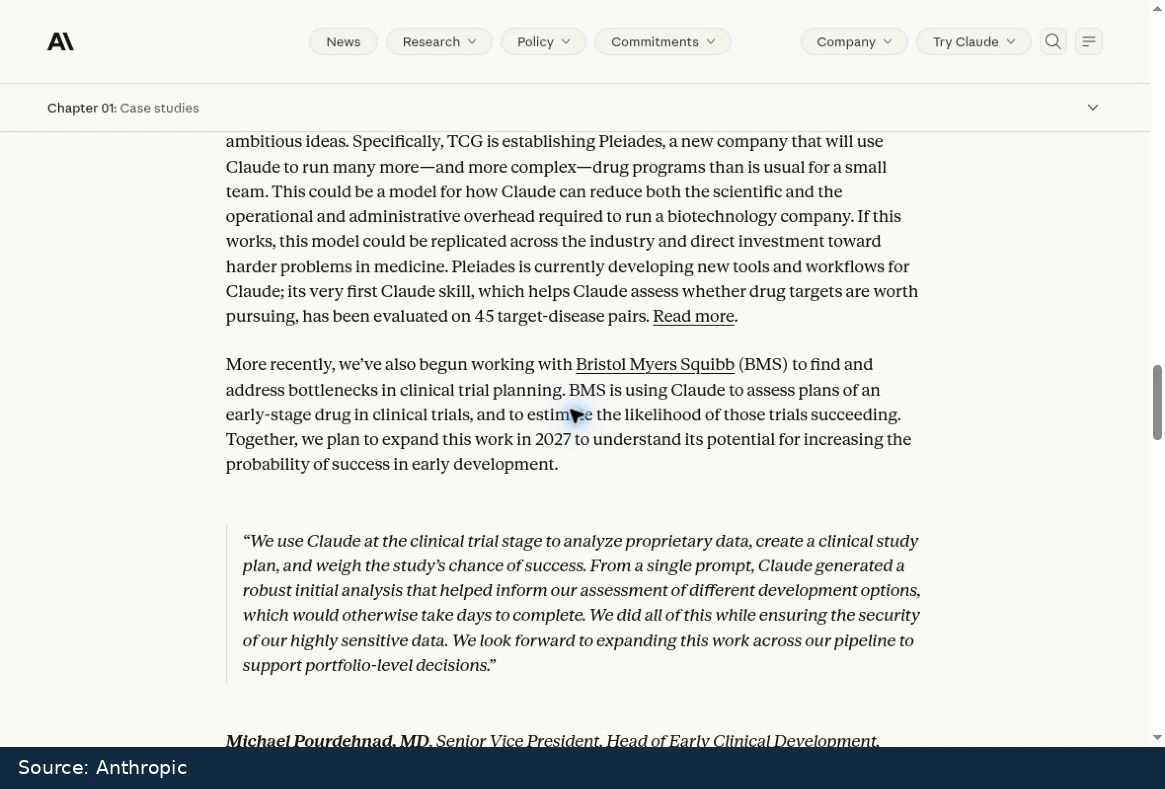
The AI Daily Brief reports on Anthropic’s acquisition of Mithril Medicine and its wider push into drug development. In its October 27 research update, Anthropic describes work across the scientific and operational tasks involved in developing medicines. The approach extends beyond proposing a molecule: it includes choosing a target, planning experiments, preparing manufacturing processes, organising regulatory documents and designing clinical trials. The company argues that delays are distributed across this process rather than concentrated in one problem that AI can solve in isolation. Its work with six organisations is intended to identify those bottlenecks through real development programmes. The channel presents the acquisition as one part of this broader strategy.

A small company with an external laboratory network
Mithril Medicine was a one-person company developing potential treatments for two rare forms of muscular dystrophy. Claude helped organise contracts, logistics and experiments involving 11 external laboratories, alongside other operational tasks. The small internal team therefore worked with a wider research network. According to Anthropic, a possible treatment for one form of the disease progressed from an idea to promising results in mice in less than 18 months. The acquisition brings those programmes into Anthropic’s own drug-development work. The AI Daily Brief also discusses the attention attracted by the company’s size: the story combines a very small organisation with outside specialists, laboratories and AI-supported coordination, rather than eliminating the need for experimental research.

Mouse results and the next development stage
The reported results are preclinical. Anthropic’s stated expectation is that a drug could be ready to begin human clinical trials as early as late 2028, if the candidates continue to hold up. That date is a conditional development target, not a completed trial or an approved treatment. The broader programme also includes a Bristol Myers Squibb partnership focused on bottlenecks in early clinical-trial planning. As the channel explains, the strategy is to reduce friction across research and administration, not to turn drug development into a fully automated process. The current acquisition and early experimental progress sit at different stages from the future clinical work.