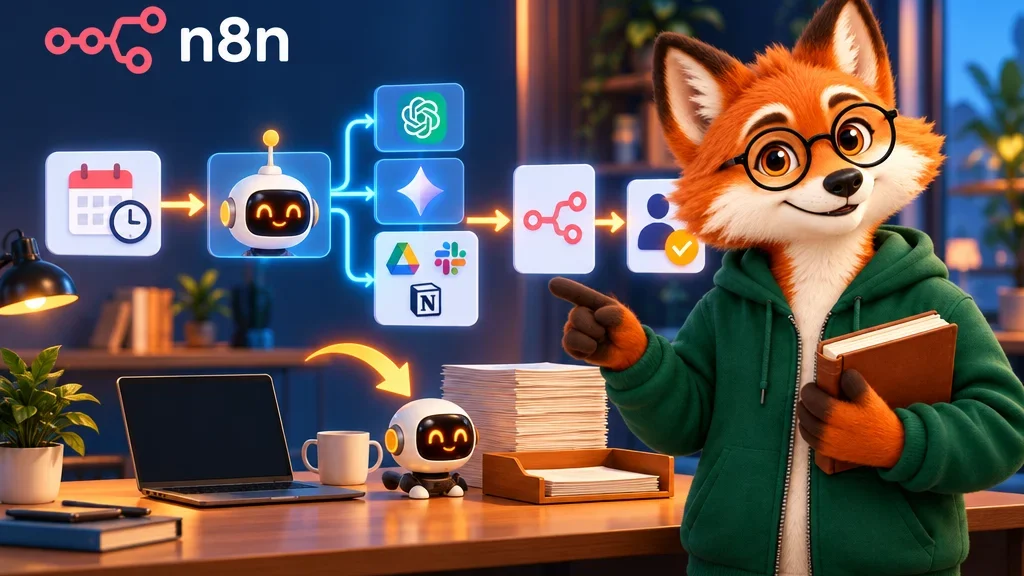

Pulling the monthly invoice out of a supplier portal, cancelling a trial before it renews, checking a competitor’s prices every few hours: small, repetitive jobs that rarely have a clean integration. On 10 November 2026, n8n Labs released Nod, a personal agent meant for exactly this kind of work. It is free, open source under the Apache 2.0 licence and available as a research preview.
What Nod is, and how it differs from n8n
A personal agent is an AI assistant that works for one person and carries out tasks across that person’s apps and websites, instead of only answering in a chat window. n8n Labs is a new team inside n8n that experiments with ideas outside the core automation product. Nod is a standalone app: you do not need an n8n account, and each installation has a single owner. n8n itself stays the place for shared team processes. If you do use n8n, you can connect it in Nod’s Apps section; Nod can then build, test and run workflows there, and a new workflow stays a draft until you tell it to publish.
Where it runs
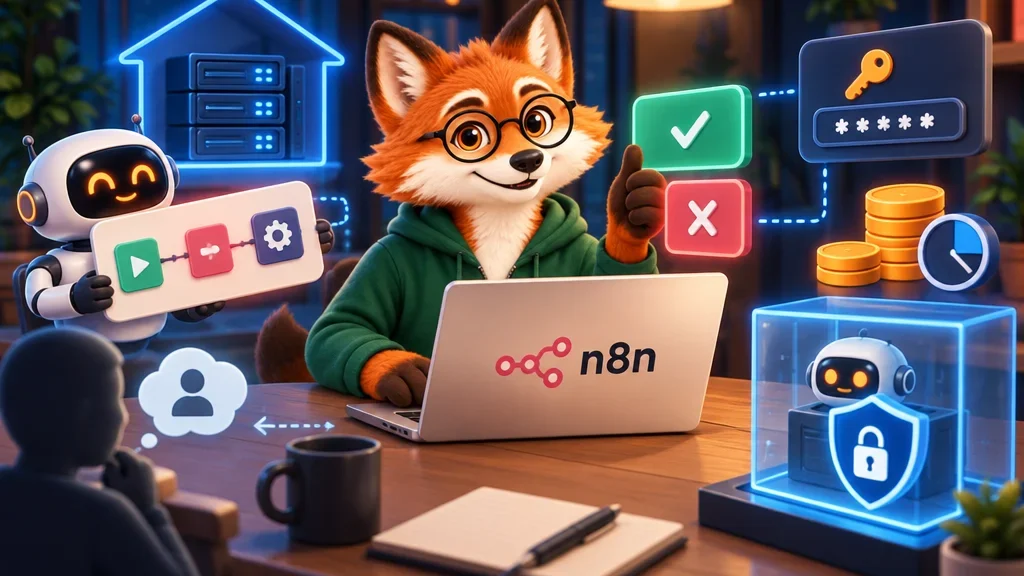
Nod works inside a private virtual machine on your own computer, with its own browser. That browser lets it operate on websites that offer no API. According to the n8n team’s announcement, the desktop app runs on macOS 14 or later and on Windows 11 (x64), where support is still in preview and requires WSL 2. There is no Linux desktop app yet, but Nod can be self-hosted on a Linux server. Your data, memory and saved logins stay on the machine that runs it.
Which models it uses and what it costs
The app costs nothing; you pay the AI provider you connect. Options include an API key from providers such as OpenAI, Anthropic, Gemini or OpenRouter, a ChatGPT Plus or Pro plan, or an open model running on your own computer. Every task shows what it cost and ends with a receipt. You can set a monthly spending limit, Nod checks in once a task passes 5 dollars (the threshold is adjustable), and each schedule shows an estimated monthly cost.
How it avoids unwanted actions
Before Nod sends, pays, posts or deletes anything you did not ask for, a separate check confirms that you actually asked for it. n8n is open that this check is itself a model and can make mistakes, which is why Nod asks whenever your words do not clearly cover an action. Content on a web page or in an email is not treated as an instruction. Saved passwords and cards are encrypted on your machine and entered through private forms the model cannot read, and every sign-in, card use and action is logged.
Memory, channels and schedules
Nod keeps a long-term memory of your conversations and preferences, and you can view, edit or delete anything it stores about you. n8n reports a score of 93.2 percent on the LongMemEval memory benchmark; that is the company’s own figure. You can talk to Nod in the app, on Telegram or on WhatsApp, and connect Gmail, Calendar, Drive and Slack. Recurring jobs such as a morning brief or a price check can run on a schedule.
The limits of the preview
On a laptop, Nod stops when the laptop sleeps; a hosted version is on the roadmap, and some testers use an always-on Mac mini or their own server instead. It cannot make phone calls, and n8n tells users to expect rough edges and frequent updates.
Our assessment
The interesting part is not that another agent exists, but where the human decision sits. Nod puts approval before anything that sends, pays, posts or deletes, keeps secrets away from the model and shows the bill per task. That is a sensible design for delegating small errands. The weak point is also stated plainly: the guard is a model too. Until there is independent testing, treat Nod as a supervised helper, start with low-risk errands, and decide up front who takes the next step when a request is ambiguous.
Ask AI about this article
Opens in a new tab with the question filled in.