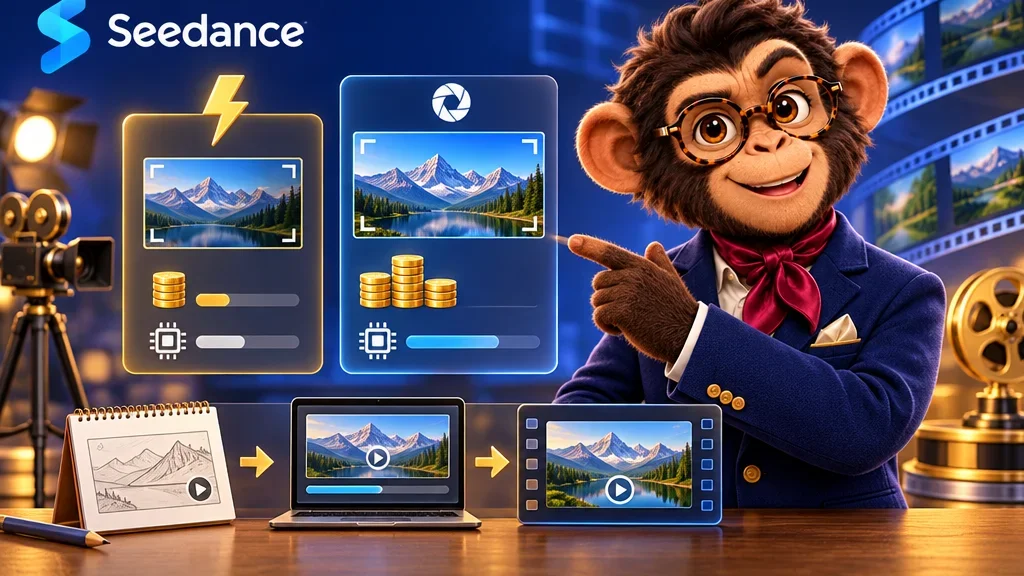
Imagine a five-second shot of a rider crossing a dusty street, rendered at 720p. On the full Dreamina Seedance 2.5 model, BytePlus estimates that clip at about 1.16 US dollars. On the new Seedance 2.5 Flash tier, the same estimate drops to 0.76 dollars. That gap is the whole pitch: a faster, cheaper version of ByteDance’s video model, with a few clearly documented trade-offs.
What Seedance 2.5 Flash is
Seedance is ByteDance’s family of video generation models, sold to developers and businesses through BytePlus ModelArk, the company’s model platform. The ModelArk home page now lists “Dreamina-Seedance-2.5-flash” as available. Its pricing documentation names the model ID dreamina-seedance-2-5-flash-261115, which is the string you pass when calling the API.
BytePlus describes Flash as about twice as fast as Seedance 2.5 and roughly 34 percent cheaper. It keeps the series’ maximum clip length of 30 seconds.

How much cheaper it is
ModelArk bills video generation in tokens. For requests without an input video, Flash costs 7.0 dollars per million tokens at 480p and 720p, compared with 10.70 dollars for the full Seedance 2.5. With a video as input, the rates are 4.3 dollars versus 6.40 dollars.
Because tokens are abstract, BytePlus also publishes estimates for a five-second 16:9 clip without video input:
At 480p, Flash comes to about 0.34 dollars per clip (0.07 dollars per second), against 0.514 dollars (0.103 per second) for the full model. At 720p, Flash is about 0.76 dollars (0.15 per second), against 1.156 dollars (0.231 per second). Both comparisons land at roughly a third less, which matches the 34 percent figure.
What you give up
The first limit is resolution. Flash outputs only 480p or 720p; the pricing page marks 1080p and 4K as not supported. The full Seedance 2.5 offers both, with a five-second 1080p clip estimated at 2.843 dollars.
The second limit is references. A reference is an image, video or audio clip you attach so the model keeps a character, location or sound consistent. According to the Seedance 2.5 prompt guide, Flash accepts up to 10 images, 5 videos and 5 audio clips per request. The full model accepts 30 images, 10 videos and 10 audio clips.
A striking frame. What about the motion? That second cut is the one I would watch most closely. Resolution is easy to judge on a single frame, but reference capacity is what keeps a face, a costume or a set the same from shot to shot. A project that leans on dozens of references to hold continuity loses more with Flash than a single-character clip does. That is my inference from the documented limits, not a published test result.
Are the speed and quality claims proven?
The “twice as fast” figure comes from BytePlus itself. The documentation we reviewed does not publish timing measurements, hardware conditions or sample sizes behind it, so treat it as a vendor claim until you time your own jobs. The same applies to quality: BytePlus positions Flash next to the flagship, not as its equal, and there is no official benchmark comparing the two on motion or consistency.
Who it makes sense for
Flash fits work where you iterate a lot: blocking out camera moves, testing prompts, previewing a storyboard, or producing social clips where 720p is enough. One practical pattern is to explore at Flash 480p, where a five-second draft costs about 0.34 dollars, and send only the chosen shots to the full model for 1080p. Keep in mind that a cheaper clip only saves money if you do not need many more retries to get a usable take.
Before switching, check two things. First, use the exact model ID with its date suffix. Second, the pricing and documentation pages we reviewed are for the ap-southeast-1 region, so confirm that the model and these prices apply to the region your account uses.
Ask AI about this article
Opens in a new tab with the question filled in.