
A larger model, with a later target
Grok 5 is still a forthcoming model in TheAIGRID’s November 1 overview. The channel brings together Elon Musk’s statements about its size, live-video understanding and tool use, then examines how those promises fit the competition and the products that could use it.
An early clip has Musk predicting a substantial lead across every metric and pointing to the first quarter. The channel contrasts that earlier timetable with a target of launching before the end of 2026. It also preserves Musk’s qualification about artificial general intelligence, or AGI: he gives Grok 5 roughly a 10% chance of reaching that level, which also means a 90% chance of not doing so. In this discussion, AGI means a system able to handle the broad range of thinking tasks people can perform.
Scale, data and live video
Musk describes a six-trillion-parameter model, compared with the three-trillion-parameter base he attributes to Grok 3 and Grok 4. Parameters are the internal values adjusted during training. The channel explains the larger capacity alongside a second claim: higher intelligence per gigabyte of memory and per trillion operations. The proposed improvement is therefore not only a bigger model, but more useful capability for the resources required to run it.

Training data is another part of the argument. The video cites plans to use SpaceX’s historical launch records, engineering material and manufacturing data, and locates Grok 5 training at Colossus II in Memphis. xAI’s January funding announcement had already stated that Grok 5 was in training. xAI announcement.
The planned model is described as multimodal from the outset, working with text, pictures, video and audio. Musk particularly emphasizes understanding a live video stream as events unfold, rather than simply inspecting a still image. The channel links that proposed ability to a phone assistant that can follow what its user sees and to robots interpreting their surroundings. It also reports promised improvements in using tools and creating tools to solve a problem. Musk mentions additional undisclosed features and says the experience could feel sentient; this is his description of an expected interaction.

The infrastructure argument
TheAIGRID connects the model roadmap with Musk’s view that hardware deployment can decide the race. In the interview excerpt, Musk argues that ideas circulate between laboratories as researchers move, often leaving only about six months between competitors. His proposed advantage is bringing more chips online sooner, with the power and cooling needed to use them.
The channel points to the original Colossus build in 122 days. Looking back to SpaceX’s first earnings call, it cites roughly 1.4 gigawatts online, an end-of-2026 goal of two gigawatts and a 2027 goal of 10–15 gigawatts. These are the earlier figures used in that account. It also describes nearly $20 billion of quarterly capital spending, mostly on AI, and computing capacity rented to other companies, including Anthropic.
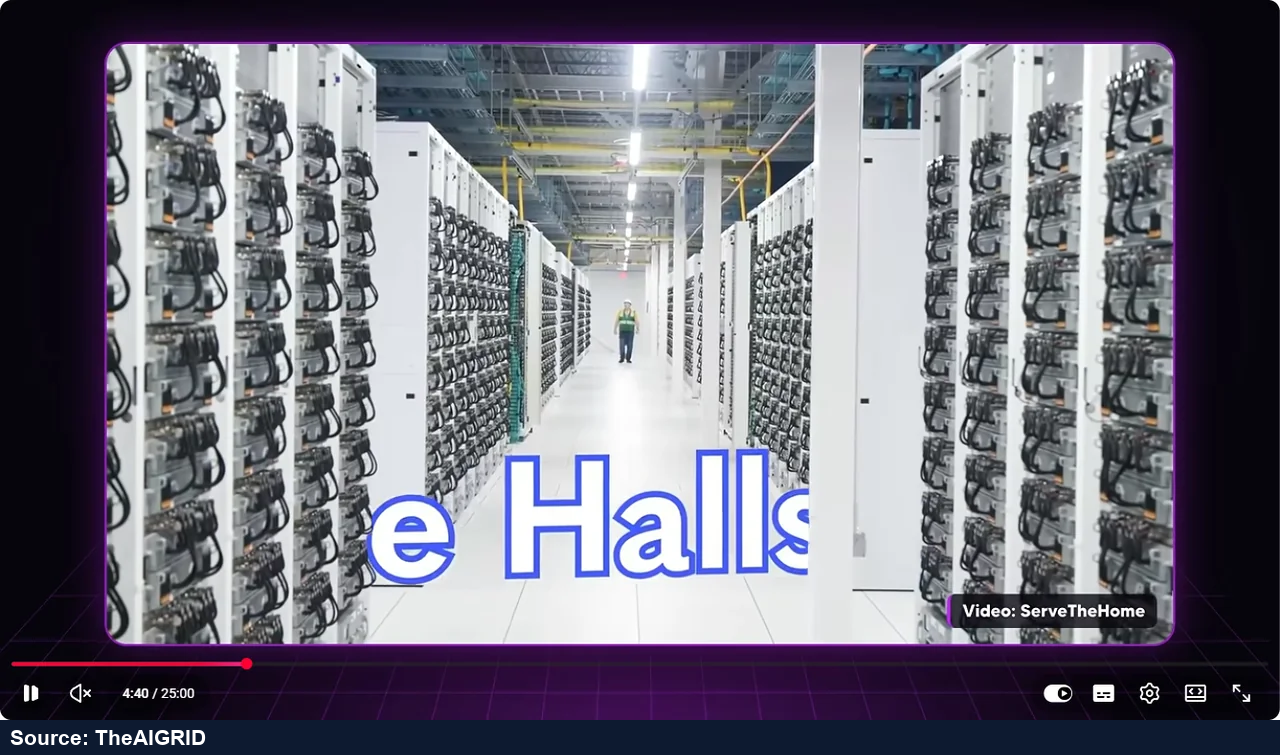
The approach is compared with Tesla’s development path: gather substantial real-world data, apply computing resources and improve through repeated work. That comparison is part of the channel’s explanation of Musk’s strategy, rather than a separate claim that the model has already achieved its goals.
What the benchmark comparisons mean
The competitive reference point in the video is Google’s rapid sequence of Gemini 4 releases. Argon was announced in late September and broadened access in mid-October; Carbon followed on October 28. The channel cites Intelligence Index scores of 50 for Argon and 59 for Carbon. Artificial Analysis’s Carbon page confirms the latter score and its leading position at the time of this review. Artificial Analysis model page.
The video keeps two comparison periods in view. On the previous Intelligence Index, it gives Grok 4.7 a score of 46 against leading results around 53. In its cited Terminal-Bench comparison, which tests agents carrying out coding work in a terminal, Grok is around 26% and GPT-6 Astra around 60%. These are the comparisons discussed in the video, not Grok 5 results.
Musk’s forecasts go much further. In a Moonshots excerpt, he suggests Grok 5 could approach a perfect score on Humanity’s Last Exam and even identify flawed questions. The same discussion cites about 52% for Grok 4 on text questions. The channel also reports an expectation that Grok 4.9 would reach the class of GPT-6 Astra and Claude Fable before Grok 5 arrives. Its own proposed reference point for Grok 5 is roughly 60 on the Intelligence Index, together with a narrower agentic-coding gap and stronger image, video and audio performance.
Why the release takes more than training
The video groups the difficulty of releasing a frontier model into five pressures. First, rivals keep launching while a new model trains, so the relevant comparison changes before release. Second, initial training is followed by reinforcement learning: practice on tasks with feedback that rewards successful behavior. The channel uses Grok 4.8 as an example, recalling a September statement that its initial training would finish that week while the product remained unreleased at the time of the video.
It also reports a new C++ training system largely built by the Starlink software team. Rebuilding that foundation and polishing behavior both take time. The third pressure is the opportunity cost of computing: chips assigned to another training week cannot simultaneously serve existing paying users. Fourth, evaluation is becoming harder. Artificial Analysis’s fifth index version puts 60% of its weight on evaluations with private test sets or held-out answers. Fifth, the channel argues that Musk’s sweeping promises increase the pressure to wait for a sufficiently strong release. Index v5 methodology.

Public tests and unseen work
The discussion then turns to benchmark optimization, often called bench-maxing: doing especially well on familiar public tests without the same advantage in everyday work. The channel cites Musk’s stated preference for usefulness rather than optimizing rankings.
Kimi K3.1 Pro supplies the comparison. The video quotes Moonshot’s own Terminal-Bench figures of 65.7%, close to 66.4% for Claude Opus 5.5. It then contrasts a fourth-place position on the older Artificial Analysis index with ninth on the new one, and an open-versus-closed-model gap that widened from three points to twelve. The channel explicitly says that this change does not establish that Moonshot trained on test questions.

A second chart discussed in the video places Grok 4.7 ninth among nine models on public coding tasks but seventh on private tasks, ahead of Claude Sonnet 5.5 and Gemini 4 Argon in that comparison. TheAIGRID sees this as a reason to watch unseen tasks and real usage when Grok 5 arrives, not only launch-day charts.
The software around the model
An agent also needs software that provides tools, memory and a way to act, inspect the outcome and try again. This surrounding system is the agent harness. The channel argues that its design can substantially change what the same model accomplishes.
It cites a reported Princeton comparison of 42% and 78% with different setups around the same model. Another example comes from Vercel, which removed about 80% of its internal agent’s tools and improved its results. Vercel’s own account describes a simpler, file-system-based approach, rather than treating a larger tool collection as the goal. Vercel’s account.

Cursor, Grok Build and Grok Bot are the products through which the video develops this argument. It describes SpaceX’s $60 billion Cursor acquisition and the subsequent OpenAI model-supply dispute. Cursor’s announcement confirms that it joined SpaceX and gained access to its GPU infrastructure. Grok Build serves developers, while Grok Bot is presented as an assistant for completing work such as email, research and sales outreach. The channel expects Grok 5’s usefulness to be experienced through these products and X, not just through a model ranking. Cursor’s announcement.
Grok Bot’s growth and the next models
The video dates Grok Bot’s beta launch to August 11 and cites 418,000 weekly users by mid-September. Separately, it attributes daily-user estimates to Similarweb: roughly 155,000 in late September, 450,000 in mid-October and more than 600,000 by late October, after sixteen consecutive days of growth. Those daily estimates are a different measurement from company-reported weekly users.
The company figure discussed next is 800,000 paid weekly users in early October, more than double the previous month. Gwynne Shotwell states that figure in SpaceX’s October 20 earnings transcript. The channel emphasizes paid adoption and the absence of a free Grok Bot tier, while distinguishing it from Grok’s much broader reach: around 117 million monthly users of its AI features in March, largely through X. SpaceX earnings materials.

TheAIGRID also places the subscriptions in the context of SpaceX’s larger business, saying that computing rentals currently contribute most of its AI revenue. It reports Musk’s plan for many Grok Bot requests to move first to a fast Grok 4.8 variant and later to Grok 5. Those are the next stages in the roadmap described by the channel, alongside the still-pending Grok 5 release.