An AI avatar can stand on a beach, in a keynote hall or on a busy street, yet its voice often sounds as if it was recorded in the same small booth every time. The picture says “outside”, the sound says “closet”. That mismatch is the problem HeyGen is targeting with HeyGen Voice, an in-house voice model the company launched on 9 October 2026.
What scene-aware cloning changes
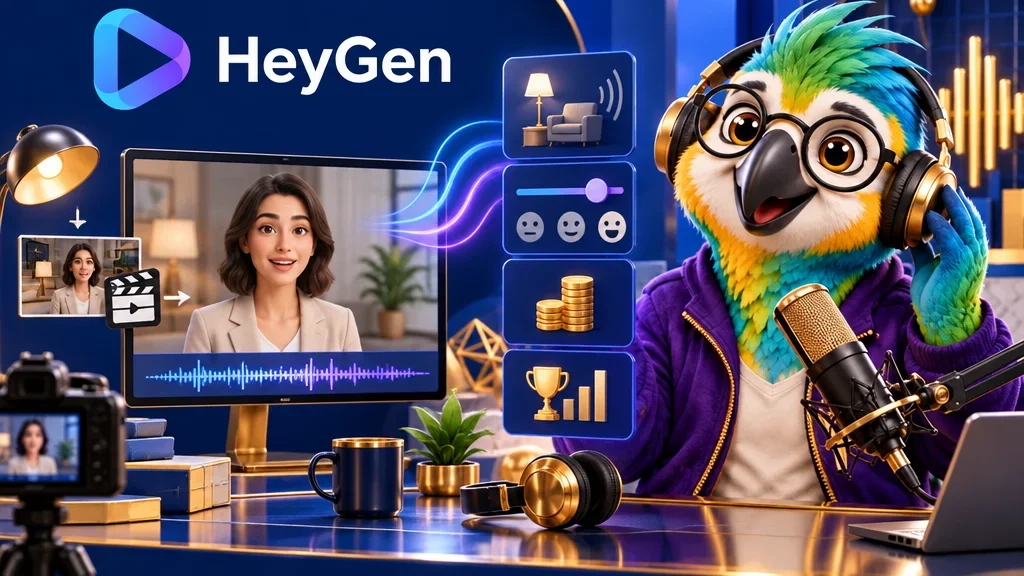
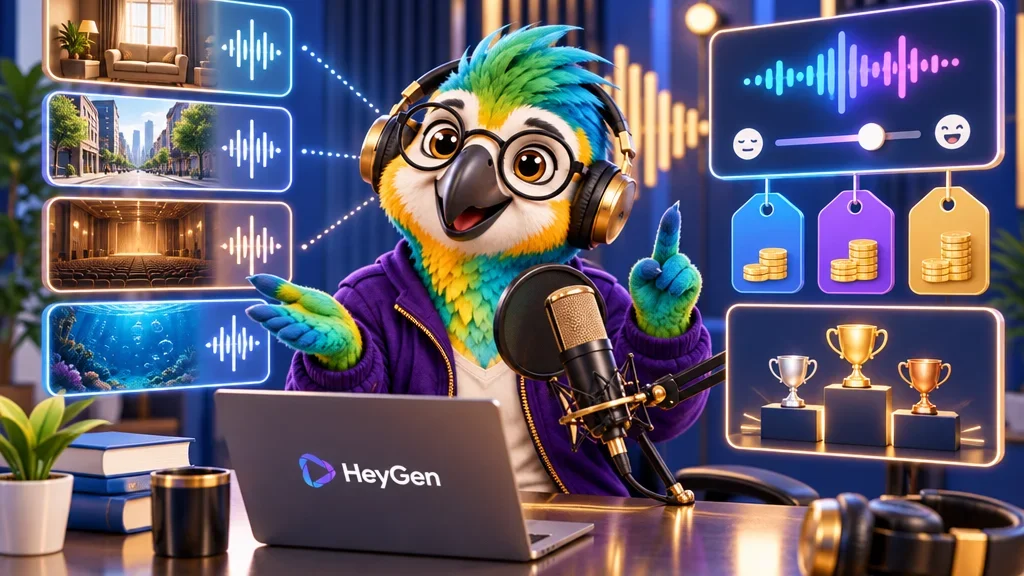
Voice cloning means building a synthetic voice from a recording of a real speaker, so new lines keep that person’s timbre, accent and phrasing. HeyGen’s research report describes a model that takes three inputs: a recording of your voice, a script and a target image. The image matters. In what HeyGen calls scene-aware mode, delivery and acoustics are shaped for the setting on screen, with examples such as a studio, an outdoor location and a large presentation room. Instead of carrying the original room and microphone into every scene, the sound is fitted to each one.
In practical terms, a creator no longer has to build separate voice styles or fix the audio scene by scene, which is work an editor would normally do by hand. The model page also lists a “Set the scene” control with three sliders: pitch variation, background level and ambient steadiness. Let your ears take a look: a close, dry studio voice and a voice that spreads through a hall are different listening experiences, even with identical words.
The Expressiveness Boost slider
Separate from the scene adaptation, HeyGen offers an Expressiveness Boost. According to the company, it is a layer trained on listener preference and scored against your reference recording, adding emphasis, rhythm and inflection. It works as a single slider from baseline delivery to full energy; setting it to zero returns the base model. A separate similarity setting offers four modes per line, from “More adaptive” to “Closer to original”.
Who can use it and at what cost
Inside the HeyGen app, an Instant Voice made from up to 60 seconds of audio is free, as are voices used in HeyGen videos. A Professional Voice Clone, which needs 30 minutes to two hours of audio, is a paid add-on from 29 US dollars per month. Through the API, text-to-speech costs 30 US dollars per million characters. A faster Turbo mode for instant voices is listed at half that price, and HeyGen’s release notes say Turbo is free to try through 30 November on shared capacity.
How much the ranking should count
HeyGen says the model debuted at number one on an Artificial Analysis voice-cloning leaderboard. That is a third-party benchmark, but such boards move quickly, and most of the head-to-head figures on HeyGen’s pages come from the company’s own preference tests. Treat the ranking as a starting point, not a verdict.
Our assessment
The interesting idea here is not a prettier voice but a voice that matches the image. That is a real gap in avatar video, because viewers notice acoustic mismatch even when they cannot name it. Still, the feature is only weeks old and the published evidence for the scene fit comes from HeyGen itself, so it is reasonable to expect uneven results, for example a line that still sounds like a studio voice in a scene that is clearly outdoors. The fair test is simple. Generate one short line in a quiet room, a large indoor space and a noisy outdoor setting, then compare them on headphones before you rely on it for client work.