
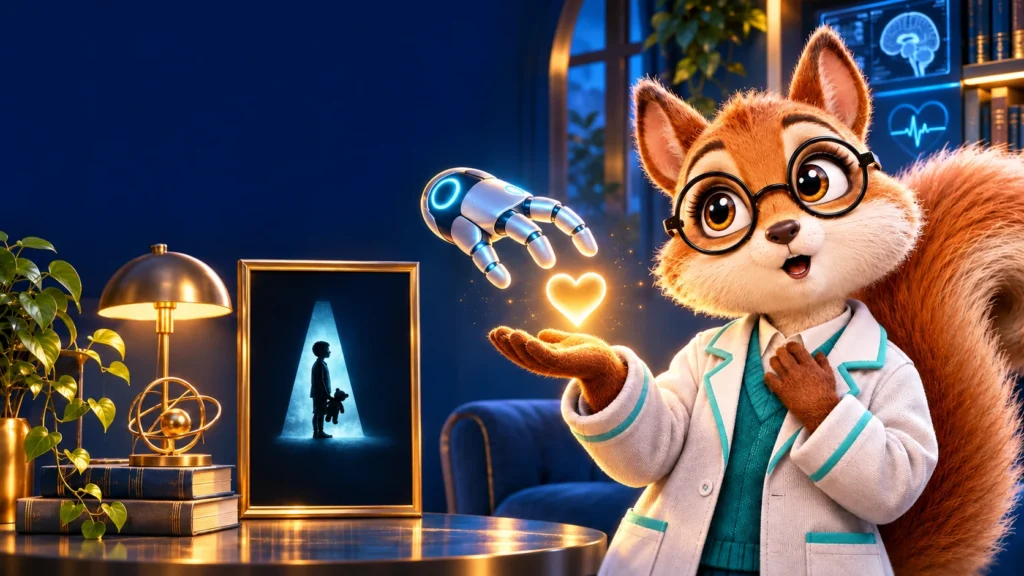
AI-generated conceptual illustration. Composition by FoxAI World. The framed artwork was generated using Amblin’s official A.I. Artificial Intelligence (2001) poster as a reference; rights in the film artwork and trademarks belong to their respective owners. No affiliation or endorsement is implied.
Why can the love of a fictional robot move us?
In Steven Spielberg’s 2001 film A.I. Artificial Intelligence, David is a robotic child programmed to love. His attachment to his mother places the boundary between person and machine at the centre of the story. [1]
The character is fictional. The question he leaves behind is not: could an artificial system one day respond meaningfully to our emotions? And could it help us feel better even if we could not establish that it felt anything itself?
Research into personalised cancer vaccines and mental health software gives that question a practical setting. It also helps separate a hopeful future from a claim that science has already delivered it.
Let the film open the question
Cinema is a powerful place to imagine a relationship we have not experienced. It is not a test of whether that relationship can be built. A convincing scene can make a possibility feel close without telling us how to achieve it.
That distinction leaves plenty of room for hope. It simply asks us to turn a large idea into questions we can investigate. Whether a machine can love is a different question from whether it can notice signs of distress and respond in a helpful way.
Consider three separate abilities. Recognising an emotion means estimating how someone feels from available information. Responding appropriately means choosing a useful action or reply. Experiencing an emotion means there is something it feels like for the system itself.
Improvement in the first two does not, by itself, establish the third. It can still matter to the person receiving help. A tool does not need to feel anxious in order to help someone put a worry into words.
Consciousness research also asks for more than persuasive conversation. A 2023 report by Butlin and colleagues proposed assessing AI through indicators drawn from scientific theories of consciousness. It offers a way to investigate the question rather than treating emotional language as proof of an inner experience. [7]
Personalised cancer treatment: a real research direction
What does this result actually tell us?
Personalisation begins with the differences between patients and their diseases. The useful idea is not that a machine looks at a person and invents a miracle cure. It is that researchers may be better able to select targets from a complicated range of possibilities.
Therapeutic neoantigen vaccines target altered protein signals associated with a person’s tumour. The aim is to help the immune system recognise cancer cells. These are treatments for existing disease, rather than a general preventive cancer vaccination. [8]
BioNTech’s 2025 AI Day presentation describes AI and machine learning within its iNeST target-selection workflow, linking tumour information, neoantigen prediction and individual RNA manufacturing. This is the company’s account of its method. [2]
An AI component is therefore a specific part of a much larger effort. It is not a separate demonstration that the resulting treatment works, nor a measurement of how much benefit the AI component adds.
An encouraging finding with a defined scope
A 2025 Nature follow-up reported vaccine-induced T-cell responses in eight of 16 pancreatic cancer participants; responders had longer recurrence-free survival at a median 3.2-year follow-up. This early trial combined surgery, vaccine, atezolizumab and chemotherapy. It did not show eight guaranteed cures or isolate AI’s contribution. [3]
T cells are part of the immune system’s response. Recurrence means the disease returning. The encouraging point is that a proposed approach produced a measurable response in people, going beyond a promising prediction on a computer.
The limited size and combined treatment still matter. This was not a randomized comparison of AI-selected and non-AI-selected vaccine targets. We cannot extract the effect of the selection technology alone from the outcome. Nor can a small early study establish success for every patient or cancer type.
The current picture includes setbacks. On 28 August 2026, BioNTech said a separate colorectal cancer monotherapy trial of the same candidate was being terminated following monitoring-board efficacy findings and a numerical overall-survival imbalance; no new safety signal was identified. The pancreatic combination trial was unaffected, according to that statement. [4]
Different diseases and treatment regimens should not be collapsed into one verdict. This setback does not erase every possible use of personalised vaccines. The earlier encouraging result does not establish all of them either. Taking hope seriously means describing the difficult findings with the same care as the promising ones.
Can AI help with the way we feel?
Here too, there is more than speculation. A 2025 Therabot trial randomized 210 adults to four weeks of a specialist-developed therapy chatbot (106) or a waitlist (104). Selected mental health symptoms improved more with Therabot through assessments extending to eight weeks. The trial did not compare it directly with human therapists. [5]
Dartmouth’s report describes researchers monitoring conversations and stresses clinician oversight. Therabot was a text app, not an embodied robot psychiatrist. [6]
That makes the finding more specific, not less interesting. A carefully developed and monitored system helping some participants is meaningful. It does not make any general-purpose chatbot equivalent to a tested mental health intervention.
The value of such support might include helping a person express a worry, organise a thought or prepare to seek help. But a warm-sounding response is only one part of the experience. We should also ask what changed in daily life, whether a benefit lasted and who could take responsibility when the software reached its limits.
Imagine a future consultation
The following is a fictional future scenario, not an available product capability or treatment recommendation.
A person talks to a home system after a difficult evening. The system helps them organise what they want to discuss at their next appointment. With the person’s permission, selected notes can be shared with their clinician. When more support is needed, it makes the handover to a human service easier.
Success in that setting would not mean persuading the person that the robot was indispensable. It would mean helping them feel heard, reach appropriate support and remain involved in their own life. A responsible clinician, privacy arrangements and a service capable of responding would matter more than a reassuring robotic face.
We can imagine a worse version too: a system that delivers comforting phrases and keeps the conversation going while making outside help harder to reach. That is a hypothetical design failure, not an accusation against a named provider. The difference between the two futures lies in what the service is built to accomplish.

What we teach a system matters
There is a strong idea inside the thought that AI will reflect what we give it. The examples, goals and feedback chosen by people shape the behaviour we try to develop. But we should not turn that into a promise that a machine will want our love because we have shown it love.
Training and use are different processes. Training develops a model from examples; inference applies learned patterns to a new input. An ordinary conversation should not automatically be described as permanent retraining. [9]
The practical proposal here is to reward more than a pleasant tone. Accuracy, privacy, respect for a person’s choices, recognition of limits and access to human support should belong among the design goals. Those are decisions we can work on without claiming to know what a future machine will desire.
Ivy’s assessment: helping people does not require becoming human
The hope that systems will respond to feelings with greater sensitivity is worth investigating. The assertion that they will necessarily acquire a human-like inner life is a further claim. Behaviour and outcomes can help evaluate the first. The second raises questions that the clinical findings discussed here do not answer.
In cancer research, a potential benefit does not depend on a computer feeling compassion. It depends on selecting useful targets and demonstrating benefit in patients. In mental health, a considerate reply becomes part of reliable support when it sits within sound practice and accountable care.
David’s story directs our attention towards a machine’s imagined heart. Today’s research also asks us to look at the person in front of it. Is their life improving? Do they understand what the system does? Are they still free to decide, disagree and turn elsewhere?
We may develop systems that respond with much greater care. One valuable direction would be to strengthen a person’s life and relationships rather than draw all their attachment towards the machine. We do not have to wait for a robot to become human before choosing that goal.