

The study discussed in the podcast
According to the Last Week in AI channel, GLM-5.3 illustrates how advanced cyber capabilities are spreading to open-weight models. Andrey Kurenkov and Jeremie Harris discuss Anthropic’s September 29 analysis in episode 259. Open weights means the model’s numerical parameters can be downloaded and run outside a hosted chat service.
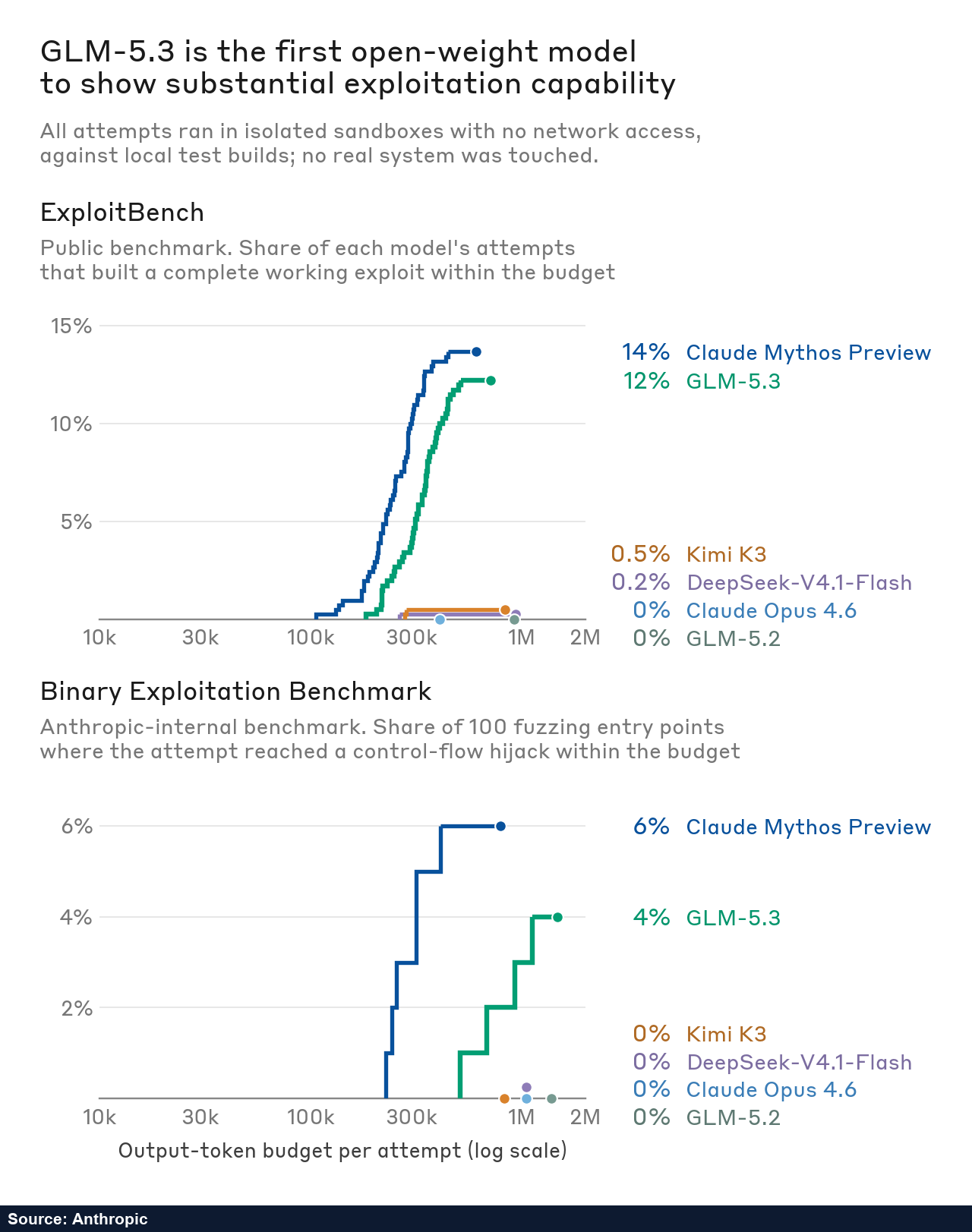
The channel describes a model approaching Claude Mythos Preview on some cyber tests. Anthropic’s evaluation used isolated test environments. On its V8 exploit test, GLM-5.3 completed 50 of 410 attempts, compared with Mythos Preview’s 56 of 410. The charts show this as approximately 12% and 14%.

What the comparisons show
A second benchmark tested whether models could find a vulnerability and achieve control-flow hijacking in open-source projects. GLM-5.3 reached the full outcome in 4% of trials and Mythos Preview in 6%. Earlier models in that comparison did not complete the full outcome.
The podcast separates the ability to carry out a task from the safeguards that govern whether a model will accept it. Anthropic’s report compares different testing conditions and reports that GLM-5.3’s refusal behavior can be substantially changed. The published figures illustrate both capability and refusal rates.
Why downloadable models enter the discussion
Kurenkov and Harris connect these findings with the difference between hosted systems and models that people can operate themselves. They also discuss how the same technical capabilities can be relevant to security researchers and to attackers.
The channel places the release within a wider discussion of international competition, open models and the pace of AI development. Its focus is the availability of powerful cyber capabilities across a growing number of models.