
The AI Daily Brief follows the debate over access to OpenAI’s newly announced physics research. The question at the center of this episode is not only what the AI-generated work claims, but who gets to examine it first and when the wider scientific community can participate.
Three results, three release approaches
OpenAI’s 26 October announcement described results in mathematics, computer science and physics. Rather than releasing all three in the same way, it consulted outside experts and adopted different arrangements for each field.
The mathematics material was made public for researchers to organize their own examination. The computer-science work combined public AI output with an external group working to explain it. For physics, the group reviewing the material chose to keep the AI-produced artifacts private while preparing its own account.

The physics claim includes the existence of quantum Yang–Mills theory. That is distinct from settling the entire Millennium Prize problem: the committee’s statement says confinement and the mass gap remain open challenges.
An independent group asks for equal access
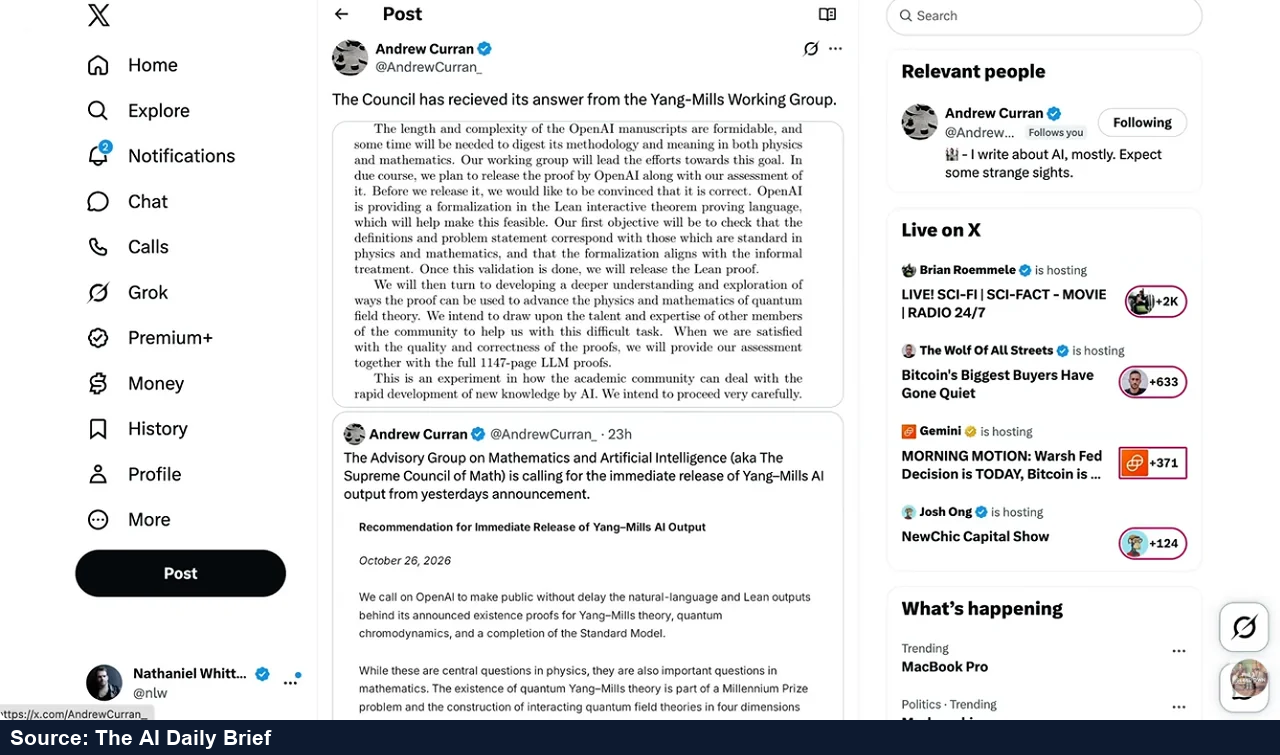
The independent Advisory Group on Mathematics and Artificial Intelligence responded with a recommendation dated 26 October. It called for the natural-language and Lean outputs behind the announced physics results to be released without delay.
As The AI Daily Brief explains, the disagreement concerns how understanding should develop. The advisory group respects the researchers reviewing the work but argues that everyone should have the same access. Its role is independent of OpenAI; it advises AI companies rather than making their decisions.
The physics committee explains its sequence
The physicists describe manuscripts whose length and complexity require time to understand. Their statement sets out a sequence: check that the formal definitions and problem statement match their usual mathematical and physical meaning, release the Lean proof after that validation, then publish their assessment with the full proofs when satisfied with their quality and correctness.
The channel presents the exchange as a tension between rapid, open access and a more carefully organized first review. Both sides are discussing how AI-generated research enters scientific practice, rather than announcing the end of scientific scrutiny.

Primary statements: OpenAI, AGMAI and the physics committee.