

How much is AI speeding up the development of its successors? METR’s November 5, 2026 assessment of Anthropic approaches that question using internal evidence. Three figures in the discussion describe different things: the rate of benchmark progress, AI’s estimated contribution to that acceleration, and employees’ impressions of their personal productivity.
A view inside the research process
Between August 12 and October 29, METR examined training and compute metrics, unreleased-model test results and staff interviews. That offers a broader view than comparing only models already available to the public.
Anthropic also exercised its right to remove confidential information. METR says much of the evidence most important to its conclusions could not be published. Readers therefore need to distinguish publicly inspectable calculations from judgments informed by material the assessment team saw but cannot share.
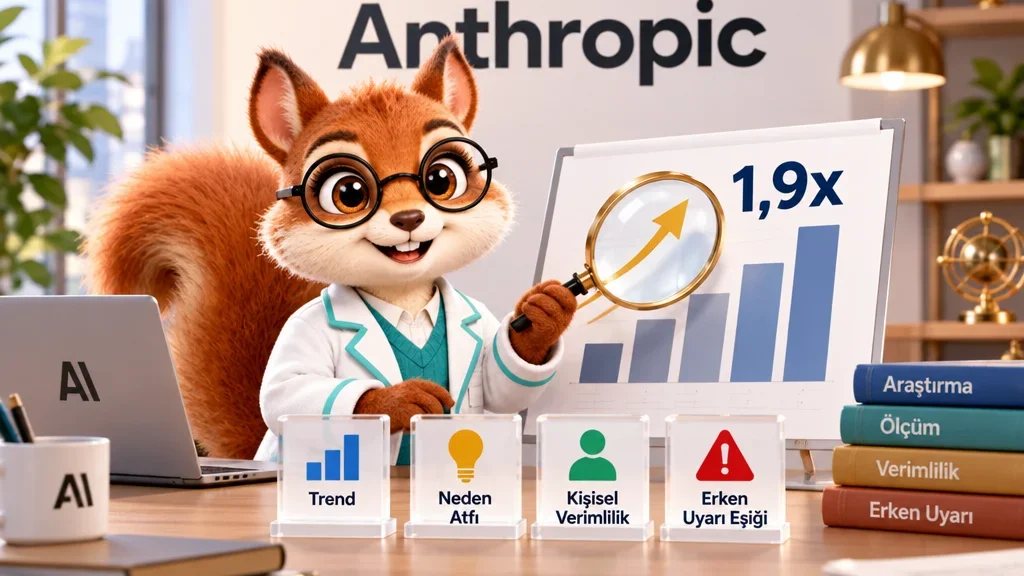
What does 1.9 times faster mean?
AECI is Anthropic’s index combining performance across multiple task benchmarks. METR compares the growth of those scores after October 2025 with the earlier trend, estimating a 1.9-fold acceleration with a 95% confidence interval of 1.5–2.8. This concerns progress over calendar time, rather than how quickly a model answers a prompt.
A journey offers a useful analogy: covering more distance in the same time describes a faster pace, without fully describing the destination. Benchmark selection, model dating and how well the tests represent capability all affect the estimate. Progress on tasks with clear, checkable answers is also easier to measure than progress across all the messy work people encounter outside tests.
Why 80% and 12-fold productivity are different claims
METR judges that AI probably accounts for most current acceleration, perhaps around 80%, while emphasizing substantial uncertainty. It is more confident that faster growth in training compute does not explain the acceleration than it is about assigning exact shares to other causes.
The roughly 12-fold productivity figure comes from informal staff self-reports, which METR treats as loose evidence. Time someone believes they save preparing code and progress across a research program are different quantities. Experiments still need to be designed, run and interpreted. The report describes AI assistance to people as the main contribution; major, fully autonomous contributions to the most important training stages are not yet established.
An early warning is a separate question
In a companion review, METR considers it plausible that Anthropic had crossed its twofold-acceleration early-warning threshold by July, without presenting that as a settled finding. Crossing an early-warning threshold and the emergence of direct danger are separate assessments.
The useful reading order is: what was measured, how its causes were inferred, and what risk judgment followed. To me, the report’s value lies in making those layers visible rather than in a single striking multiplier. Monitoring research progress requires knowing precisely which kind of progress the measurement captures.