
You give Claude Code one job, come back later, and find it has split the work across a crowd of helpers and burned through a large share of your weekly allowance. Was that necessary? Anthropic’s own documentation gives a fairly clear answer, and it is more restrained than most agent tutorials suggest: several agents pay off for a specific kind of work, and for everything else a single conversation is the better tool.
What a subagent actually is
A subagent is a helper that Claude starts for one side task. According to the Claude Code documentation, it runs in its own context window, meaning its own working memory, with its own system prompt, tool access and permissions. It does the work there and hands only the result back to the main conversation.
That detail explains the whole idea. Searching a codebase or reading long logs fills the main conversation with text you will never look at again. A subagent keeps that noise in its own memory and returns a summary. Claude Code ships with built-in helpers for this, such as Explore for read-only code search, Plan for research in plan mode and a general-purpose agent for multi-step tasks.
You also do not have to request them. The documentation says Claude delegates automatically, based on your request, the description of each available subagent and the current context. If you never read the longer status messages, you may simply not notice that it happened.
Where several agents really help
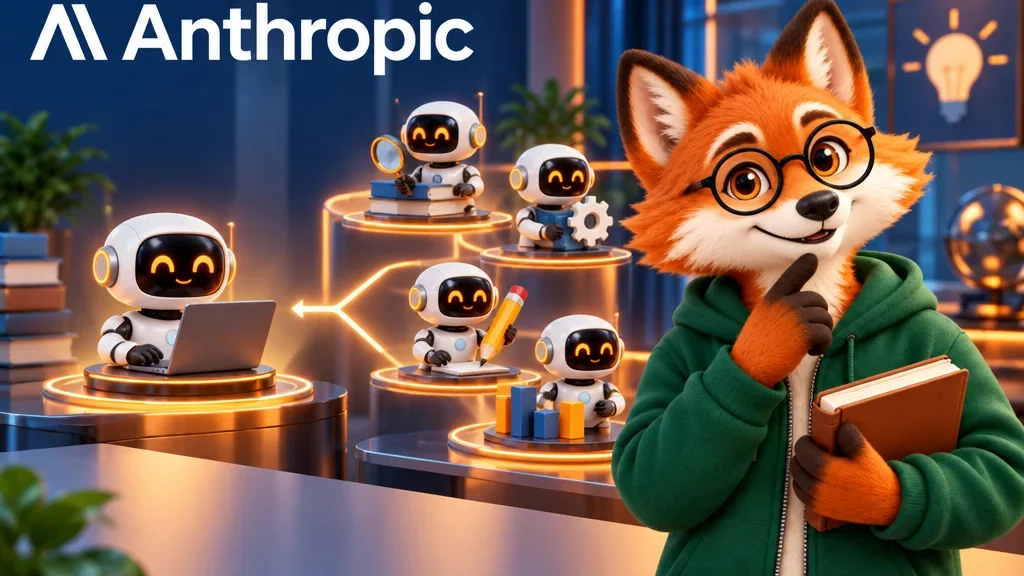
Anthropic described its multi-agent research system in an engineering post from June 13, 2025. Its conclusion: multi-agent setups excel at open-ended, breadth-first questions where several independent directions can be followed at the same time, where the information does not fit into one context window and where many tools are involved.
The gain is mostly time. Anthropic reports that parallel subagents and parallel tool calls cut research time by up to 90 percent for complex queries. The Claude Code documentation makes the same point on a smaller scale: parallel research with separate subagents works best when the paths do not depend on each other.
Where they get in the way
The same post is direct about the limits. Multi-agent systems are a poor fit when all agents need to share the same context or when the pieces depend heavily on one another. Anthropic adds that most coding tasks contain fewer truly parallel subtasks than research does, and that agents are not yet good at coordinating with each other in real time.
The Claude Code documentation turns this into a short list. Stay in the main conversation when the task needs frequent back-and-forth, when planning, implementation and testing share a lot of context, when you are making a quick, targeted change, or when speed matters, because a fresh subagent first has to gather its own context.
What it costs
Anthropic’s numbers are blunt: agents typically use about 4 times more tokens than a chat interaction, and multi-agent systems about 15 times more. A token is the unit in which text is counted and billed. In one of Anthropic’s evaluations, token usage alone explained 80 percent of the performance differences, so part of what several agents buy you is simply the ability to spend more tokens on a problem.
For Claude Code this has a practical side. Every subagent sends its own requests, and they count toward the same usage limits as your main conversation. I would not carry the factor of 15 over to coding as if it were a measurement; it comes from a research system. The direction is what matters: each additional helper spends its own budget while it runs, whether or not the task needed it.
How many are enough
Anthropic wrote scaling rules into the prompts of its research system: one agent with 3 to 10 tool calls for simple fact-finding, 2 to 4 subagents for direct comparisons, and more than 10 subagents with clearly divided responsibilities only for complex research. Claude Code sets technical ceilings as well. By default up to 20 subagents can run at once, and subagents may start their own helpers up to three layers deep. Both values can be lowered in the settings.
Those ceilings are limits, not recommendations. A task that fits the first rule does not get better because the tool would allow twenty helpers.
A simple decision rule
In its guide to building agents from December 19, 2024, Anthropic advises finding the simplest solution possible and increasing complexity only when needed, because agentic systems often trade latency and cost for better task performance.
From these three sources I draw one test, and it is my reading rather than an official rule: could two parts of the job be finished without either one seeing the other’s result? Researching five unrelated libraries passes. So does reworking separate pages that share no logic. Redesigning a single landing page does not, because every section depends on the decisions made for the others. If the test fails, one conversation is cheaper and usually faster. If it passes, split the work, give each helper a clear boundary and ask for a summary back. Who takes the next step? In most everyday tasks, still the one agent you already have.